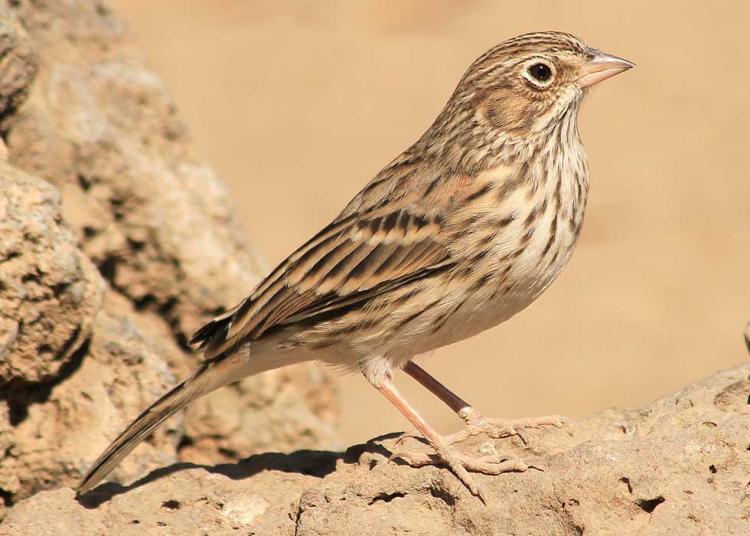
The Oregon Vesper Sparrow (Poocetes gramineus affinis) is one of four Vesper Sparrow subspecies recognized in North America. The Oregon Vesper Sparrow breeding population is disjunct, completely separate from all other Vesper Sparrow populations and subspecies. It’s restricted breeding range is recognized as a distinct population segment under the federal ESA (including parts of Georgia Depression, and Puget Lowlands in Washington; Willamette, Umpqua and Rogue valleys in Oregon). Probably one of the most imperiled (sub-)species in North America.
Vesper Sparrows are a medium sized sparrow with three distinguishing characteristics: a chestnut or rufous shoulder patch (lesser coverts), white-edged outer tail feathers, and a buff-white eye ring. The Oregon Vesper Sparrow has medium grayish-brown upperparts and white underparts with a buff tinge. The legs are pinkish and the bill is dusky brown with a pinkish lower mandible. Sexes are similar in plumage; juveniles similar to adults but duller, and lack the chestnut shoulder patch. It is relatively larger and longer-tailed compared with other similar looking sparrows. Oregon Vesper Sparrow is smaller overall and has a shorter tail than the Great Basin Vesper Sparrow. The Oregon Vesper Sparrow’s song is distinct – with sweet introductory notes and rising and falling pattern of phrases. The species appears to have very high breeding site fidelity. The subspecies is migratory, and overwinters in California west of the Sierra Nevada Mountains and south of San Francisco Bay.
Overview
Species Common Name Oregon Vesper Sparrow
Species Scientific NamePooecetes gramineus affinis
Federal Listing Status Proposed, Species of Concern
Oregon Vesper Sparrows use grasslands with high structural diversity for foraging and nesting. These typically include grassy areas interspersed with trees and shrubs and some bare ground. The Oregon Vesper Sparrow is migratory, and overwinters almost entirely in California.
Limiting factors
Declines in Oregon Vesper Sparrow populations have been linked to the loss and degradation of grassland habitat, a threat that persists across their range. Compared to pre-European settlement conditions, only small fragments of native grassland and savanna habitat remain within their historic range in Oregon. Many of the remaining grassland habitats have been further degraded by invasive plant infestations and fire suppression. Agricultural practices, particularly the timing of mowing, also likely pose a threat to this species. Oregon Vesper Sparrows are vulnerable to predation by domestic cats, ground squirrels, skunks, and raccoons. The small, isolated nature of many populations may be a limiting factor in itself. Local extirpations have occurred even in the absence of detectable habitat changes. The range of this subspecies has contracted in recent decades, with disappearances from historic nesting areas, and overall population trends are stable or declining.
Data gaps
• Limited knowledge on many aspects of Oregon Vesper Sparrow ecology precludes a confident assessment of limiting factors.
• Map nesting areas in the Willamette Valley, Umpqua Valley, and Rogue Valley.
• Undertake periodic inventory/occurrence of the entire range of the subspecies.
• Measure Oregon Vesper Sparrow response to restoration activities.
• Increase sample sizes to obtain vital rates for Oregon Vesper Sparrows.
• Determine and map wintering areas for Oregon Vesper Sparrows using banding and tracking.
• Assess geographic variation or genetic depression for Oregon Vesper Sparrows.
• Determine whether habitat is limiting recovery of the subspecies or whether small isolated populations are limiting.
Conservation actions
• Implement actions identified in the interagency Oregon Vesper Sparrow working group work plan (2024).
• Maintain or restore grassland habitat. Increase plant diversity to support greater insect diversity.
• Control key invasive plants impacting habitat suitability near known or potential breeding sites for Oregon Vesper Sparrow.
• In the Willamette Valley, reduce or avoid mechanical operations during nesting (mid-May to mid-July).
Key reference or plan
Conservation Assessment for Oregon Vesper Sparrow (Pooecetes gramineus affinis). Petition to List Oregon Vesper Sparrow (Pooecetes gramineus affinis) as Endangered or Threatened under the federal Endangered Species Act. Read here
Land Manager’s Guide to Bird Habitat and Populations in Oak Ecosystems of the Pacific Northwest. Read here
Oregon Vesper Sparrow Petition October, 2017. Read here
Population and Habitat Objectives for Landbirds in Prairie, Oak, and Riparian Habitats of Western Oregon and Washington Version 2.0. Read here
The Willamette Valley Landowner’s Guide to Creating Habitat for Grassland Birds. Read here