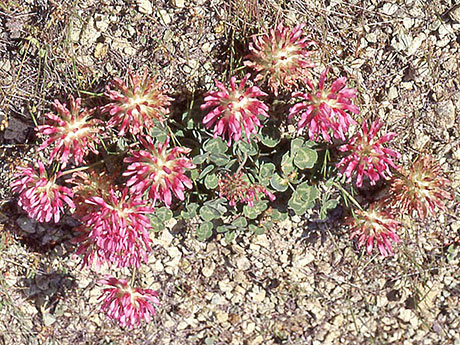
Owyhee clover is a glaucous perennial with one to several spreading stems up to 20 cm long growing from a thick woody taproot, often with numerous rhizomes. Leaves are few on petioles up to 2.5 times the length of the leaflets. Leaflets are thick and broad, green with white crescents, more or less emarginate, and sparingly denticulate. Leaflets three, the central leaflet 0.9 (-1.2)-2.0 cm long by 0.7 (-1.4)-2.3 cm wide, the two lateral leaflets somewhat oblique and tending to slightly overlap the central leaflet. Stipules are thick, foliaceous, and slightly lobed, each pair partially fused at the base. The rounded flowering head is 2.5-4 cm long, comprised of 20-30 flowers, and lacks an involucre. The calyx tube is villose, inflating with age, 0.5-0.6 (-0.8) cm long, the subequal linear teeth nearly as long as the tube and with soft-aristulate apices. The corolla is 1.2-1.8 cm long, the banner rose colored above and whitish at the base, the tips of the keel and sometimes the wings a deep reddish rose. Seeds are elliptic and spotted, with 2-3 produced per flower.
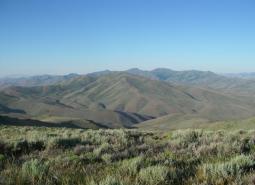
This species is endemic to the Owyhee Uplands. Owyhee clover occurs on barren slopes or mounds composed of talus and loose soils derived from tuffaceaus/ashy parent material.
Limiting factors
Invasive weeds can displace Owyhee clover. Ground disturbance by livestock, spraying and seeding associated with rangeland improvements, road construction, and off-road vehicle traffic can also harm this species. Potential habitat loss from development of mining claims is an additional threat. This species is highly vulnerable to climate change, due to its dependence on specific habitats for all or part of the year.
Data gaps
Develop transplanting protocols, and investigate required soil symbionts. Focus seed collection on capturing potential genetic diversity.
Conservation actions
Mitigate for range projects that are potentially damaging to the species. Minimize ash and gravel excavation in sensitive areas. Manage recreational activity in sensitive areas. Monitor existing populations. Collect and bank seed as insurance against local extirpation or extinction and to use in ex-situ research. Conduct ex-situ seed/plug production for introduction and augmentation efforts.
Key reference or plan
ODA conducted a germination and cultivation study in 2021. Plants never flowered and require soil symbiont, but were maintained in greenhouse conditions for multiple years.