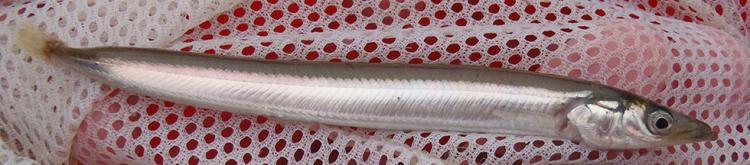
Pacific sand lance are small, silver fish with long, thin bodies and a very long dorsal fin. They are green or blue on their back and silvery below. They have a small, upturned mouth. They can form dense schools. Pacific sand lance bury themselves in bottom sediments and their scientific name, Ammodytes, reflects that, coming from the Greek for “sand” and “dive”. Like other schooling forage fish Pacific sand lance are an energy rich food source for many ocean predators and an important link in the marine food web off our coast. Over 100 species of birds, fishes, and marine mammals eat them. Pacific sand lance can grow to 11 inches long and weight up to about 3.5 ounces. They can live 6 to 7 years and mature between 2 to 4 years. Pacific sand lance spawn between August and April, depending on location. They may use the same places to spawn year after year. Spawning can happen during the day or night. Females lay all of their slightly sticky eggs in a single batch. Females lay their eggs from the shallow subtidal zone up to 16 feet above the low tide mark in some locations. Eggs are laid in sand or fine gravel and hatch between 13 and 67 days with embryos hatching earlier in warmer water conditions. Juveniles and adults can be found in shallow water over eelgrass and algae beds, as well as over sand, cobble and bedrock. Pacific sand lance live from the intertidal to depths of at least 330 feet. They eat mainly zooplankton.
Overview
- Species Common Name Pacific sand lance
- Species Scientific Name Ammodytes personatus