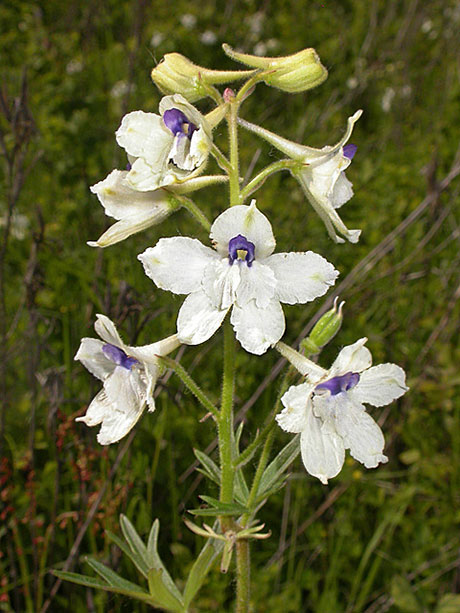
Peacock larkspur is a leafy perennial 30-90 cm tall that grows from a cluster of globose tubers. The deeply cleft leaves are mostly cauline, becoming bract-like above, the lowest leaves with petioles up to 22 cm long. Flowers are arranged in a pyramidal raceme, with lower pedicels much longer than the upper ones. The sepals are white to cream, sometimes slightly greenish blue on the back and greenish at the tip, and more or less reflexed to spreading. The lower petals are white or faintly bluish tinged toward the base and glandular-pubescent with a hairy tuft at the base of the blade. The upper petals are bluish to lavender-tipped. The follicles are up to 1.6 cm long and often glandular-pubescent.
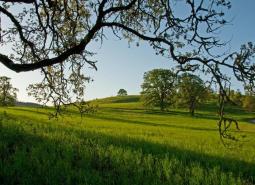
Peacock larkspur is found in low, flat areas of the Willamette River floodplain. It occurs in wet prairies, shady edges of Oregon ash and Oregon oak woodlands, and along roadsides and fence rows.
Limiting factors
This species is endemic to the Willamette Valley. The primary threats to Peacock larkspur include habitat loss, habitat degradation due to fire suppression, competition from invasive plants, and herbicide use on roadsides and adjacent agricultural fields. Overspray of herbicides may also impact this species. Hybridization with other species may also be a threat.
Data gaps
Conduct reproductive biology and pollinator studies. Investigate hybridization.
Conservation actions
Maintain or restore grass-dominated habitat. Maintain or restore hydrology. Control key invasive plants. Use mowing or prescribed fire to control brush and trees. Maintain populations in roadsides and ditches. Collect and store seeds. Improve signage and coordination of habitat management on roadsides.
Key reference or plan
A U.S. Fish and Wildlife Service Recovery Plan for prairie species of western Oregon and southwestern Washington was released in 2010 and addresses conservation needs of peacock larkspur. https://ecos.fws.gov/docs/recovery_plan/100629.pdf
Marshall, DA. 2025. 2025 listing status assessment for Delphinium pavonaceum (Peacock larkspur). Oregon Department of Agriculture, Salem, Oregon.