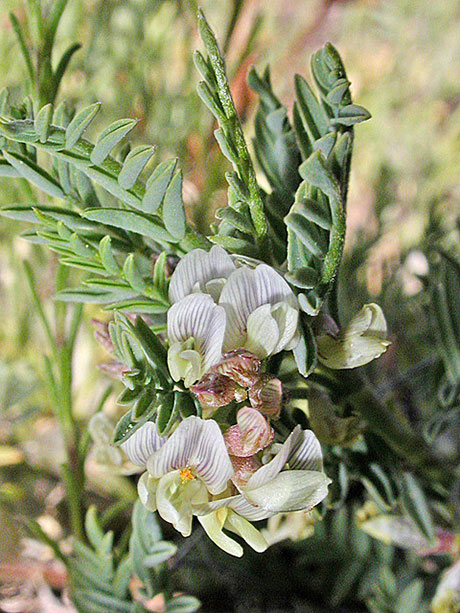
Peck’s milkvetch is a prostrate perennial with a deep taproot. The reddish stems reach 1-3 dm long, and leaves are pinnately compound with 8-14 leaflets per leaf. Leaf petioles persist from year to year, giving plants a skeletal look during winter dormancy. (Interestingly, Peck’s milkvetch is the only North American milkvetch to have persistent petioles.) Mature plants produce small, cream or pale yellow flowers in numerous axillary racemes of 5-9 flowers. As is typical of plants in this family, flowers are papilionaceous (shaped like butterflies), and fruits resemble very small pea pods. Fruits are 5-8 mm in length at maturity, and typically contain one or a few seeds, although many fruits produce no seeds at all. Plants begin to produce new leaves in March, and flowers begin to open in late May or early June and can continue blooming through July.
Overview
- Species Common Name Peck's milkvetch
- Species Scientific Name Astragalus peckii
- State Listing Status Threatened
Ecoregions

Blue Mountains
Located in NE Oregon, the Blue Mountains ecoregion is the largest ecoregion in the state. It provides a diverse complex of mountain ranges, valleys, and plateaus that extend beyond Oregon into the states of Idaho and Washington.

East Cascades
The East Cascade ecoregion extends from the Cascade Mountains' summit east to the warmer, drier high desert and down the length of the state. This ecoregion varies dramatically from its cool, moist border with the West Cascades ecoregion to its dry eastern border, where it meets sagebrush desert landscapes.