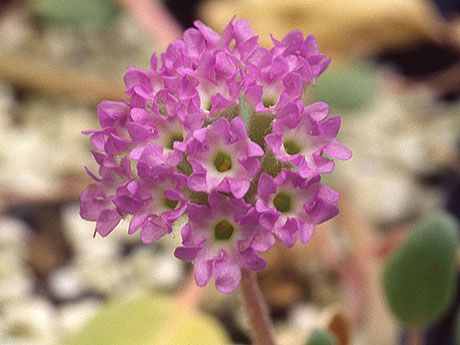
Pink sandverbena can be either an annual or occasionally a short-lived perennial. It is a tap-rooted glandular-puberulent forb with few to several prostrate branches up to 1 m (-1.5) long. Leaf blades are fleshy, light green, oval to oblong-ovate with somewhat irregular margins, 2-6 cm long, with slender petioles about as long as the blades. Flowers are grouped in ball-like clusters of 8-20 (average 14-15) subtended by 5 (4) lanceolate involucral bracts, with clusters born at the ends of stalks growing out from the stems. Individual plants produce from one to thousands of flower clusters, depending on conditions. The perianth is glandular-puberulent, the perianth tube greenish or yellowish to pink and 0.6-0.8 cm long. The corolla limbs are pinkish-purple to deep reddish-magenta, 0.5-0.8 cm broad. Flowers have a yellowish-white eyespot 0.25-0.3 cm in diameter surrounding the throat. The fruit is a single-seeded anthocarp, usually 1.0-1.2 cm long, with 3-5 broad wings that are usually equal to or wider than the fruit body and often prolonged above the fruit apex.
Overview
Species Common Name Pink sandverbena
Species Scientific NameAbronia umbellata var. breviflora
Pink sand verbena is found in open, sandy habitat (dunes and beaches). Usually occurs on beaches in fine sand between the high-tide line and the driftwood zone, in areas of active sand movement. This species requires ephemeral sites created by storms.
Limiting factors
Pink sand verbena has narrow habitat requirements. Habitat loss due to European beachgrass invasion and impacts from off-highway vehicles threaten this species. Winter storms can destroy plants but also create new habitat and disperse seeds. The species is highly vulnerable to climate change, partially due to predicted sea level rise and increased variability in temperatures.
Data gaps
Develop methods to recruit new plants into wild populations. Identify factors that contribute to yearly fluctuations in population size. Develop information on metapopulation structure and migration between sites, as well as long term seed viability in soil seedbanks.
Conservation actions
Continue efforts to control European beachgrass and manage off-highway vehicle use at known sites of occurrence. Continue to monitor populations. Conduct surveys to determine if additional populations exist. Coordinate conservation actions and recovery efforts with those for other rare coastal natives, such as Western Snowy Plover.
Key reference or plan
An interagency Conservation Strategy for pink sandverbena was developed by the U.S. Forest Service, U.S. Bureau of Land Management, Oregon Parks and Recreation Department, and Institute for Applied Ecology in 2006.