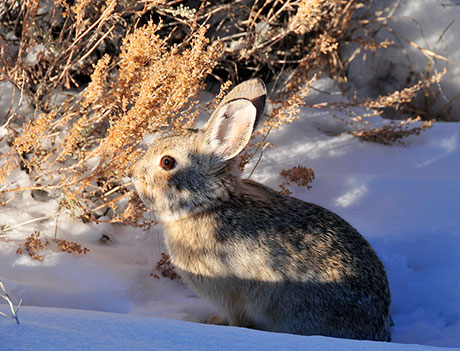
The pygmy rabbit is the smallest rabbit species in North America, with adults weighing an average of 400 g. The female is somewhat larger than the male. Fur is color is gray, but lighter in autumn and winter than in spring and summer; hairs are banded with blackish tips, buff-colored mid-shafts, and dark gray at the base; the ears are heavily furred with a buffy color along the edge. The hind feet and nape are buffy cinnamon in color. The pygmy rabbit lives exclusively in sagebrush habitat where stands of big sagebrush, Artemisia tridentata, occur over deposits of suitably textured soils at least 30 cm deep. Soil types are most commonly sandy or silty soil with low clay content but pygmy rabbits have also been found in soils with greater clay content.
Overview
- Species Common Name Pygmy Rabbit
- Species Scientific Name Brachylagus idahoensis
- Federal Listing Status Species of Concern
- State Listing Status Sensitive
Ecoregions

Blue Mountains
Located in NE Oregon, the Blue Mountains ecoregion is the largest ecoregion in the state. It provides a diverse complex of mountain ranges, valleys, and plateaus that extend beyond Oregon into the states of Idaho and Washington.

Northern Basin and Range
The Northern Basin and Range ecoregion covers the very large southeastern portion of the state, from Burns south to the Nevada border and from the Christmas Valley east to Idaho. It is largely a high elevation desert-like area dominated by sagebrush communities and habitats.