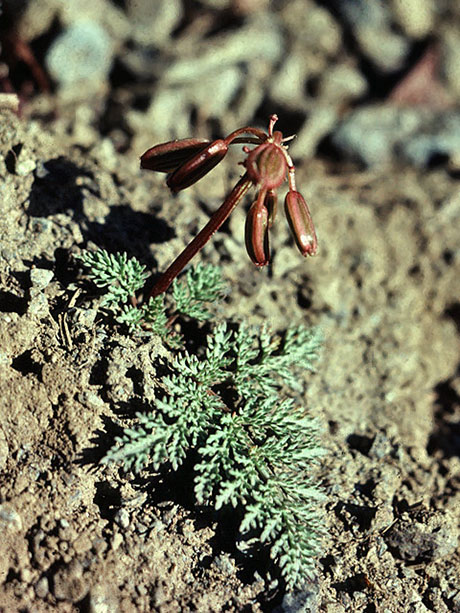
Red-fruited lomatium is a perennial species, acaulescent or very short-stemmed, and glabrous throughout. This is a diminutive plant, growing to only 2-7 cm tall, including the flowering stalk. Stems, petioles, and peduncles are often purplish. There are usually 1-3 olive-green glaucous leaves that are highly divided, the rachis broadly winged, the blade 1.0-3.5 cm long and 0.5-2.7 cm wide when expanded, and the petiole 0.4-2.0 cm long. Leaves lie flat against the substrate. Flowers are borne in umbels and are white or purplish. Fruits are glossy, often reddish when mature, oblong-elliptic, and 0.7-0.9 cm long by 0.4-0.5 cm wide.
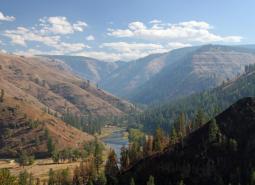
Red-fruited lomatium is endemic to high-elevation, open habitat in the Elkhorn Mountains. This species is found on steep south- and east-facing slopes in gravelly soils. Red-fruited lomatium occurs primarily on one soil type, Elkhorn argillite, but is occasionally found on limestone soils. The species is extremely vulnerable to climate change, because of natural and anthropogenic barriers that limit its ability to shift its range, dependence on specific habitat conditions, and predicted increases in temperature.
Limiting factors
This species is naturally rare, with extremely limited geographic distribution. The main threats to this species are due to impacts from mountain goat trampling, grazing, and dust-wallowing and hiking trails.
Data gaps
Given highly variable numbers, conduct demographic studies and identify factors driving fluctuations; determine whether observed variation in population density is simply an artifact of census methodology. Assess seed viability, longevity, and germination rates. Evaluate the effects of recreational trails and grazing by wildlife on this species.
Conservation actions
Continue monitoring populations to assess trends and identify their drivers. Conduct surveys to determine if additional populations exist.