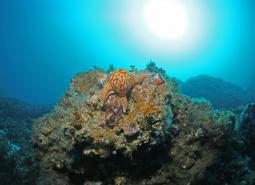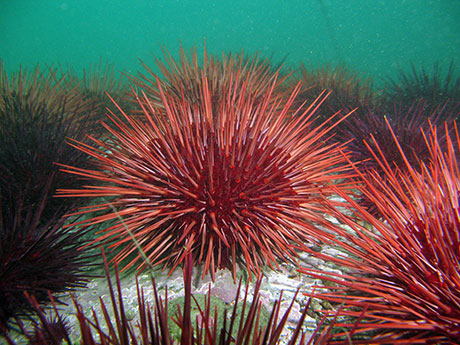
Red sea urchins are large (10 to 18 cm diameter), red to dark-burgundy sea urchins with a radially-symmetrical globular outer skeleton (test) that supports numerous long (5 to 8 cm) sharp spines. They typically inhabit rocky areas in the subtidal zone (5 to 90 m) but also occur in intertidal areas and deeper waters to a depth greater than 280 m. Juvenile feed on diatom films and turf algae, and the adults use their 5 teeth (Aristotle’s Lantern) to graze and chew though seaweeds, holdfasts stipes, and blades of kelps. They have separate sexes and broadcast spawn their gametes freely into the surrounding seawater. Mature female red sea urchins can spawn 100,000 to 2 million eggs, and the embryos develop into 4-arm and 8-arm echinopluteus larvae that drift and disperse in ocean currents for about 4 to 15 weeks. Red sea urchins are preyed upon by wolf eels, red rock crab, sunflower sea stars (Pycnopodia helianthoides), leather stars (Dermasterias imbricata), other sea urchins and sea otters. Red sea urchins typically have a long lifespan of over 100 years, and some individuals are estimated to be over 200 years. Red sea urchins are an important ecosystem engineering species that exerts strong control over the dynamics of marine communities in subtidal rocky habitats. As herbivores that actively graze seaweeds and kelp, their feeding activities have important effects on the species composition of understory seaweeds, small kelp, larger canopy kelp, and their associated communities of fishes and marine invertebrates. The spine canopy of red sea urchins provides biogenic protected habitat for small sea urchins, abalone and other marine organisms. Populations of red sea urchins can periodically undergo large fluctuations in abundance, driven by variability in larval supplies and episodic recruitment. Red sea urchins are the target of an economically important commercial fishery in Oregon. The biogeographic range extends from Northern Japan and Alaska (AK) to Baja California (MX).
Overview
- Species Common Name Red sea urchin
- Species Scientific Name Mesocentrotus franciscanus