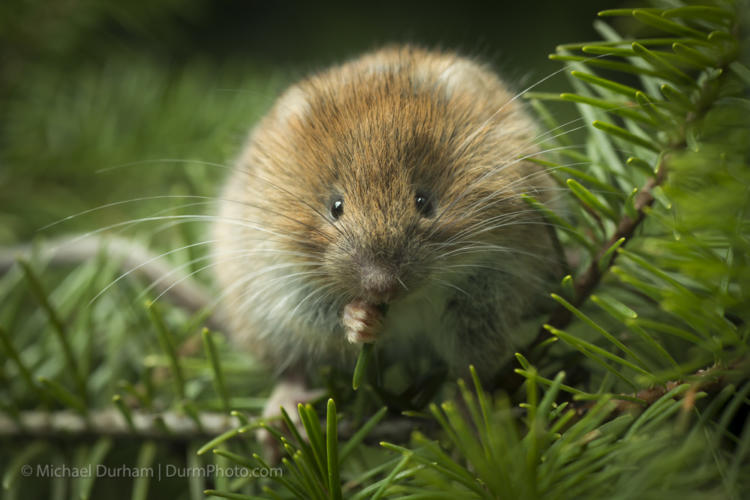
A male red tree vole (Arborimus longicaudus) eating a Douglas fir needle. Red tree voles are rarely seen. They are nocturnal and live in Douglas fir tree tops and almost never come to the forest floor. They are one of the few animals that can persist on a diet of conifer needles which is their principle food. As a defense mechanism, conifer trees have resin ducts in their needles that contain chemical compounds (terpenoids) that make them unpalatable to animals. Tree voles, however, are able to strip away these resin ducts and eat the remaining portion of the conifer needle. Photo Credit: Michael Durham, https://www.flickr.com/photos/oregonwild/
The red tree vole is a small rodent native to the wet coniferous forests of the Pacific Northwest, found in western Oregon and northwestern California. The red tree vole is arboreal, spending nearly its entire life in the forest canopy, where it feeds on the needles and bark of conifer trees, particularly Douglas fir. Red tree voles are less than 8.2 inches long (50 percent accounted for by its long fur-covered tail) and weigh up to 1.7oz. Fur color ranges from brownish red to bright brownish-red or orange-red. Red Tree voles are solitary with single adults (and young) per nest. Tree nests are constructed of discarded resin ducts, conifer cuttings, vole fecal pellets, and sticks.
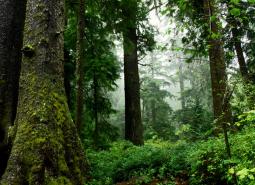
Red tree voles are arboreal rodents that inhabit dense, moist conifer forests. They prefer large stands and have a highly-specialized diet, primarily of Douglas fir needles. They require large branches for protection of nests, which are typically at least 50 feet above ground. Tree voles are also found in young forests (< 80 years old) on private lands, particularly near old forests. Red tree voles are generally restricted to lower elevation coniferous forests, although there are a few records of this species above 4,265 feet. Management goals and protection for the red tree vole are generally thought to be compatible with those for the threatened northern spotted owl and other late-successional forest species, including barred owl management/removal.
Limiting factors
Red tree voles have low reproductive rates, small home ranges, limited mobility, and low dispersal capabilities. With small numbers of voles moving very short distances, this significantly limits the capability of tree voles to expand across the landscape and to connect with other population clusters. They are vulnerable to habitat loss from timber harvest, wildfire, development, recreation, roads, and other human-caused disturbances. There is increasing predation pressure from nonnative barred owls. Swiss needle cast, a foliage disease specific to Douglas fir caused by the fungus Phaeocryptopus gaeumannii, is potentially a threat to voles in severe outbreaks, especially during drought.
Data gaps
• Refine survey methods.
• Estimate home range sizes, dispersal distances, and migration patterns.
• Improve understanding of habitat relationships, including effects of forest management on vole populations, breeding success in young forest stands, and stand requirements for persistence (e.g., minimum number or size of conifer trees, connectivity).
• Conduct genetic studies.
Conservation actions
• Continue to monitor voles in response to forest management activities.
• Conduct surveys in forested lands prior to timber harvest, and protect high-priority sites.
Key reference or plan
Survey protocol for the Red tree vole. 2012. USDA Forest Service and Bureau of Land Management.
USFWS. 2023 Species status assessment for the north Oregon coast distinct population segment of the red tree vole (Arborimus longicaudus). Version 2.0. U.S. Fish and Wildlife Service, Portland, Oregon. Read here
Lesmeister, D.B., and J.K. Swingle. 2017. Field guide to red tree vole nests, U.S. Department of Agriculture, Forest Service, Pacific Northwest Research Station. Read here