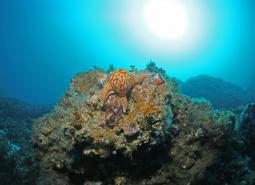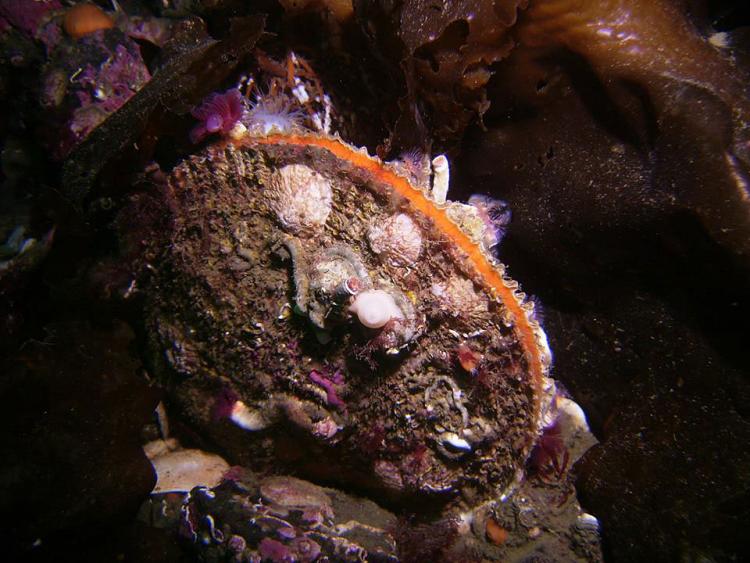
Rock scallops are marine bivalves that have their right valve affixed to a hard surface (usually a rock or boulder), where it becomes deformed to fit the contours of the rock. The left valve is roughly circular but irregular in outline, thick and heavy, with deep radial ribs. The shells of rock scallops are generally brown on the outside, glossy white on the inside, and with a purple patch at the hinge. They grow to a diameter of 15 cm in the intertidal zone and 25 cm in the subtidal zone, and they occur in crevices, under boulders, and attached to hard surfaces down to a depth of 80 m. The shells of rock scallops are frequently encrusted with sponges, bryozoans, hydroids barnacles, sea anemones, and other epifouling organisms. Like other scallops, they are a filter-feeder that captures phytoplankton from seawater as it passes over the gills. The sexes are separate, and adults spawn their gametes freely into the surrounding seawater, and the planktotrophic veliger larvae drift in ocean currents for a period of about 5 to 6 weeks. Juveniles are motile (not attached) and able to relocate themselves by clapping their shells together, and they can attach temporarily to the substrate with byssal threads. Rock scallops are preyed upon by sea stars, octopi, and fishes, and they are the target for a small fishery in Oregon. The biogeographic range extends along the Pacific Coast of North America from British Columbia (BC) to Baja California and mainland Mexico (MX).
Overview
- Species Common Name Rock scallop
- Species Scientific Name Crassadoma gigantea