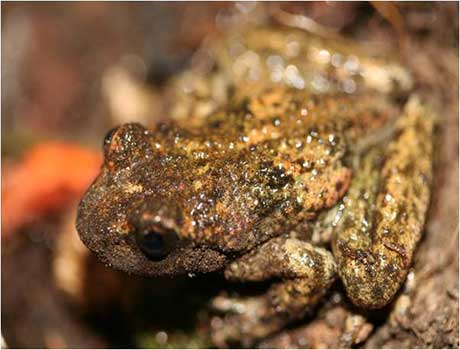
There are two species of tailed frog found in Oregon: the Rocky Mountain tailed frog found in the Blue Mountains, and the coastal tailed frog on the west side of the state. Tailed frogs are adapted to mountain streams with flattened bodies, hardened toes on the front feet, and long back legs. Tailed frogs can be identified by their unique vertical pupils and lack of external ear drums. The two species of tailed frogs are best differentiated by their geographic range, as they look very similar. Rocky Mountain Tailed Frogs have rough, grainy skin that is variable in color and a dark eye stripe. Their backs range in color from tan, brown, reddish-brown, green, gray or mottled gray in color with patches of yellow. Males have a small tail, for which the species is named. Males grow to an average of 1.75 inches snout to vent, and females grow to an average of 2 inches. The larvae have a round, sucker-like mouth that they use to graze for food and to hold on to rocks in fast flowing water. Tadpoles can be anywhere from cream to black in color.
Rocky Mountain tailed frogs breed in clear, cold streams. Larvae are typically found in reaches with cobbles or boulders and are adapted to cling to rocks and scrape diatoms. Adults forage for insects at night. Rocky Mountain tailed frogs are strongly philopatric with limited home ranges; movement between habitats is limited and understudied.
Limiting factors
The main causes of population declines in Rocky Mountain tailed frogs have been attributed to forest management practices that cause alterations to stream flow or result in increases in sedimentation and water temperature (e.g. road construction). Alterations to the natural habitat, such as deforestation, urbanization, and the construction of dams or roads, can lead to habitat loss and fragmentation. This species has a low reproductive rate due, in part, to multi-year larval development and the small number of eggs produced per female. Wildfire can impact Rocky Mountain tailed frog habitat by reducing canopy cover and terrestrial vegetation that shades streams, leading to increased stream temperatures.
Data gaps
• Increase basic knowledge of abundance, distribution, and trends through inventory and monitoring of Rocky Mountain tailed frogs throughout their geographic range.
• Describe population dynamics.
• Improve understanding of life history traits, habitat associations (including reliance on upland habitat), and juvenile movement patterns.
• Evaluate the impacts of various land management practices on water temperature, sedimentation, and in-stream woody debris, as well as reduce moisture levels in adjacent terrestrial habitats.
• Evaluate the effects of livestock grazing and predation by non-native fish on tailed frogs.
• Evaluate the effects of land management practices, fertilizers, pesticides, and herbicides on this species.
• Assess impacts of climate change to this species.
Conservation actions
• Identify, protect, and provide connections among key habitat areas, including upland refugia.
• Maintain the integrity of stream substrates and microclimates at occupied sites.
• Protect vegetation buffers around occupied sites.
• Reduce stream substrate disturbance.
• Retain upland canopy cover.
• Restrict chemical applications, within suitable habitat to prevent inadvertent impacts
• Reduce non-native predator populations in streams
• Manage livestock grazing within suitable habitat to minimize negative impacts to stream habitat quality
Key reference or plan
Olson, D.H. 2010. Conservation Assessment for the Rocky Mountain Tailed Frog in Oregon and Washington (Ascaphus montanus) Read here