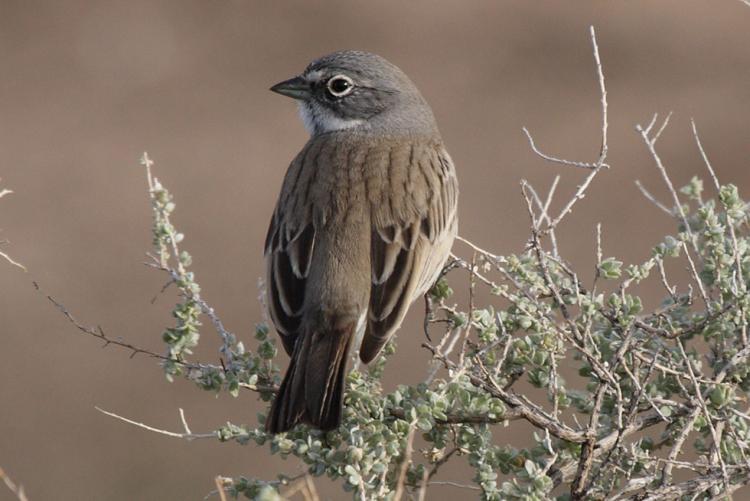
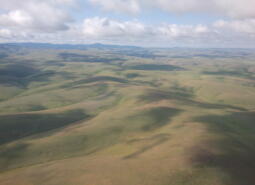
The Sagebrush Sparrow is a widespread breeder in shrub-steppe habitats associated with big sage from alkaline basins to high plateaus. It is a medium-sized sparrow (length 12–15 cm, and weighs 15–22 gm). Sexes are similar in appearance, but males are larger. Head is gray, brownish gray above, back and wings are browner. White spot in front of eye (over lores); thin eye-ring, and broad white moustachial stripe; blackish diffuse ‘malar’ stripe at sides of throat. Mostly gray-white underparts and dark spot on chest. Sides and flanks light buffy gray, with dusky streaking. The tail is contrastingly dark black/brown.
Sagebrush Sparrows are sagebrush obligates, and are found in shrub-steppe habitat, particularly in big sagebrush communities. They require high shrub cover and low grass and litter cover in relatively large patches. They exhibit high site fidelity. Winters in southern Nevada and in southern U.S. deserts (southern California, along the Colorado River, AZ, NM, and TX) and Mexico.
Limiting factors
Threats to Sagebrush Sparrows include the loss and fragmentation of sagebrush habitat. High-intensity, high-frequency wildfires promote the spread of invasive grasses, which negatively impact habitat quality. Sagebrush Sparrows avoid areas dominated by dense, annual invasive plants such as cheatgrass. The species is highly sensitive to habitat fragmentation and grazing practices, nesting only in large patches of sagebrush. Concerns have also been documented regarding the condition of overwintering habitat. Additional interrelated threats include western juniper (Juniperus occidentalis) encroachment into sagebrush habitat, altered fire regimes, and livestock grazing, all of which degrade suitable habitat for the species.
Data gaps
• Determine area requirements and conditions needed to maintain ‘source populations’.
• Determine home ranges for species and demographic vital rates.
• Evaluate the effects of Brown-headed Cowbird (Molothrus ater) parasitism on breeding success.
• Evaluate the impacts of ground squirrel predation on nesting success.
Conservation actions
• Maintain large patches (>400 acres) of shrub-steppe habitat with habitat features suitable for Sagebrush Sparrows. Guidance in Oregon includes sagebrush cover at 10-25% and height >20 inches, with <10% invasive annual grasses and open ground cover >10%.
• Monitor impacts to habitat integrity (removal and fragmentation) and juniper encroachment.
Key reference or plan
Sagebrush Communities in the Intermountain West. Read here
Rockwell, S. M., A. L. Holmes, and B. Altman. 2022. Conservation strategy for landbirds in sagebrush-steppe and riparian habitats of eastern Oregon and Washington. Version 2.1. Prepared for Oregon-Washington Partners in Flight, Bureau of Land Management, and U.S. Forest Service. Klamath Bird Observatory, Ashland, OR. Read here