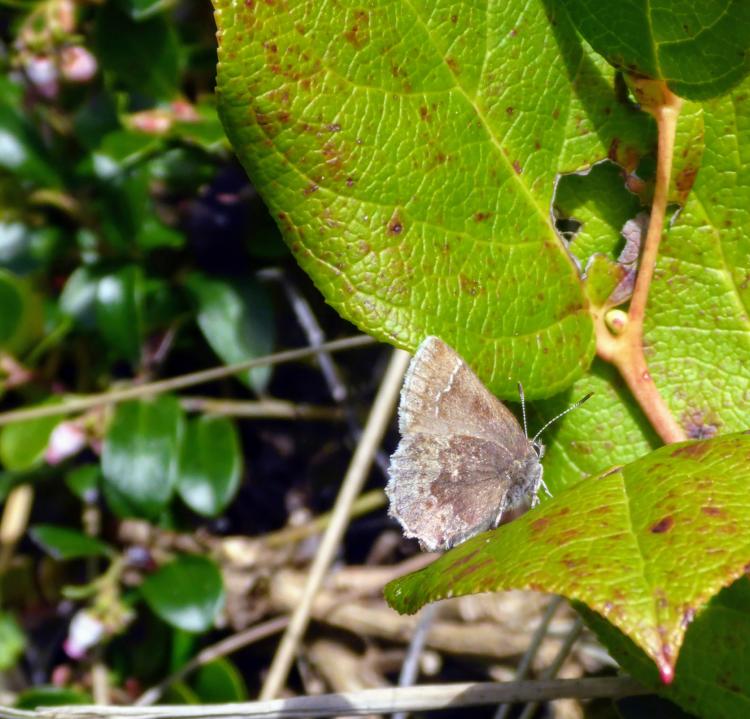
Species is small, with a forewing length of ~ 12.5 mm. The dorsal surface (upperside) of the wings is dull grayish brown with an area of tan to orange-tan overscaling in the basal and postbasal areas of the forewing, and may have orangish tan overscaling (males) or pale gray with dark brown overscaling (female) near the anal angle of the hindwing. Males exhibit a pale brownish gray androconial scale patch on the forewing. The ventral surface of the wings is dull black-brown (males) or black and pale gray to sometimes reddish (females) with a broad marginal area of pale gray overscaling, particularly on the hindwing.
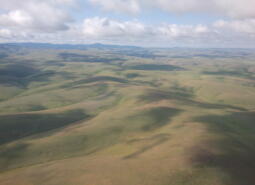
Occupies relatively undisturbed sites on coastal sand flats and associated shore pine forest edges. They are closely associated with the kinnikinnick (aka bearberry) larval host plant. This subspecies is known from only three sites globally, and two of these are in Oregon (Pistol River State Park and Driftwood Beach State Wayside).
Limiting factors
With their narrow distribution (subspecies is endemic), they are vulnerable to habitat loss due to development and habitat alteration due to fire suppression. Invasive vegetation may displace native plants that provide adult nectar sources and larval host plants. Hiking, biking, and off-road vehicle use may disturb and degrade habitat.
Data gaps
Obtain population estimates at occupied sites. Improve understanding of life history and population trends. Assess distribution and determine range throughout Oregon. Determine response to habitat restoration.
Conservation actions
Monitor known populations. Protect occupied habitat. Restore coastal bluff grasslands. Remove invasive vegetation and reduce woody succession. Avoid pesticide use in and around occupied habitats. Survey for new populations in suitable habitat.