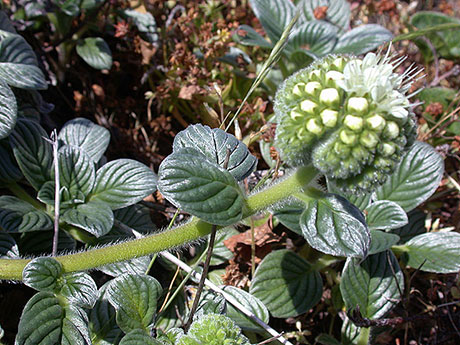
Silvery phacelia is a perennial arising from an often much branched and elongated caudex. Stems are stout, decumbent to ascending, and 10-45 cm long, the stems and petioles white hispid to hispidulous with fine, upward-appressed hairs. Leaves are thick, entire or with a pair of leaflets below the main blade, 5-12 cm long by 2-3 cm wide, elliptic to orbicular or obovate, and densely covered with silky long hairs, the vein pattern outlined by furrows on the upper surface. Robust plants often have lower leaves with well-developed axillary rosettes and occasionally with elongated floral branches bearing multiple cymes. Floral branches are often clustered near the apex. Calyx lobes are densely hispid on the margins and abaxial surfaces and are 3-4 mm long at anthesis. The corolla is white to ivory, campanulate, and 5-7 mm long by 4-6 mm wide.
Overview
- Species Common Name Silvery phacelia
- Species Scientific Name Phacelia argentea
- Federal Listing Status Threatened
- State Listing Status Threatened