Smooth mentzelia is a low annual, 5-12 cm tall. The dark stem is stout, erect, branching, and puberulent but not scabrous, at least when young, the hairs barbed at the tips. The leaves are crowded below, oblong-lanceolate or oblanceolate, obtuse, sessile or subsessile, and less puberulent than the stem. Leaf margins are entire, slightly wavy, or with one or two low teeth. Flowers are borne in small terminal clusters, nearly sessile and subtended by 2-3 reduced leaves. The calyx segments are broadly lanceolate and 0.4-0.6 cm long, the bright yellow petals narrowly ovate and 1.0-1.2 cm long. Stamens number 40-50 and are shorter than the petals, with filiformsubulate filaments. The style is much longer than the stamens, the stigma capitate. The capsule is 4-sided and about 2.5 cm long.
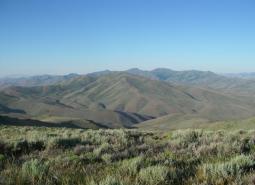
Smooth mentzelia occurs on dry, open, green or grey montmorillonite-derived soils from the Succor Creek formation. This species is typically associated with areas of abnormally high potassium content (popcorn clay), at elevations of approximately 2500-4420 feet.
Limiting factors
This species is threatened by road construction and maintenance, off-road vehicle use, grazing, mining, range improvement practices, range fires, and trampling by hikers. Climatic fluctuations, drought, and the absence of pollinators may also impact smooth mentzelia. The species is extremely vulnerable to climate change, particularly due to predicted increased variability in precipitation.
Data gaps
Improve understanding of reproductive biology. Develop propagation and transplanting protocols. Analyze genetic variation within and among populations. Compare morphological traits of northern and southern populations.
Conservation actions
Ban significant ground-disturbing activities that could harm this species. Fence populations on public land to reduce grazing impacts. Conduct photo-monitoring of trampling caused by researchers. Experiment with revegetation in disturbed sites. Survey and monitor known sites.