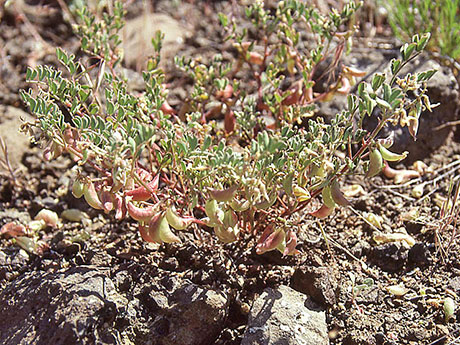
South Fork John Day milkvetch is a tap-rooted annual, or possibly short-lived perennial, with several cespitose, spreading, strigose stems 10-40 cm long. Leaves are 3-5 cm long with slender petioles. Leaflets number 9-15, are oblong to obovate, glabrous above and strigose beneath, and 0.5-1.0 cm long. Racemes are short, fewflowered, and are borne on peduncles mostly shorter than the leaves. The calyx is strigose and approximately 0.4 cm long, the subulate teeth equaling or nearly equaling the tube. The corolla is cream or purplish-tinged and 0.5-0.8 cm long. Pods are inflated, ovoid-reniform, finely whitish-strigillose, sessile, 1.5-2.0 cm long and over half as wide. Pods are 1-celled but the lower suture is slightly intruded and forms a thin partial partition.
Overview
- Species Common Name South Fork John Day milkvetch
- Species Scientific Name Astragalus diaphanus var. diurnus
- State Listing Status Threatened