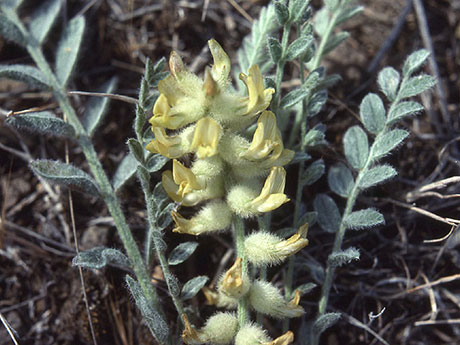
Tygh Valley milkvetch is a densely villous-tomentose perennial arising from a thick, woody taproot and shortly forking caudex. Stems are several to numerous, usually 1555 cm long, and prostrate to weakly ascending, forming loose mats or tufted clumps. Leaves are pinnately compound, 5-14 cm long, the uppermost subsessile, with (7) 1525 flat leaflets 0.6-1.7 cm long, ranging from oval-obovate and obtuse or subacute to elliptic and acute in some upper leaves. Peduncles are 5-12 cm long; racemes (10) 2040 flowered, the flowers crowded into a dense head at anthesis, elongating into a narrowly cylindric spike. The calyx is densely silky-villous, 6.6-7.8 mm long at anthesis, with narrowly subulate teeth nearly equaling the tube. The corolla is pale yellow, 9-12 mm long, the petals pubescent dorsally above the middle and marcescent. The pod is horizontal or slightly declined, contracted at the base into an obliquely attached stipelike neck 0.4-0.6 mm long, the body obliquely ovoid, 4.5-7 mm long and 3 mm in diameter, and more or less enclosed by the calyx.
Tygh Valley milkvetch is found on dry, rocky soils with thin, sandy surface soil. This species occurs in bunchgrass grasslands, mounded prairies, or open juniper habitat. Many occurrences along roadsides.
Limiting factors
Tygh Valley milkvetch is endemic to Wasco County. Habitat loss and competition from invasive plants are primary threats to this species. Competition can reduce germination and growth of this plant. Road construction and maintenance, off-road vehicles, and grazing are also threats. Roadside vegetation control (herbicide spraying) may harm insect pollinators and thereby seed production in some areas. The species is highly vulnerable to climate change, particularly due to restricted dispersal/movement capabilities and predicted alterations to hydrologic regimes.
Data gaps
Develop propagation and transplanting protocols.
Conservation actions
Use mowing rather than herbicide spraying to control vegetation at sites where this species occurs. Control invasive plants. Manage grazing at priority sites. Survey potential habitat. Protect and maintain existing habitat. Collect and bank seed as insurance against local extirpation or extinction and to use in ex-situ research.