Photo Credit: Washington Department of Fish and Wildlife
Washington ground squirrels are small squirrels with pale, smokey gray pelage and a black tip to the tail, distinguished from other ground squirrels by their small size and distict white dorsal spotting. The Washington ground squirrel is endemic to the Columbia Plateau in Oregon and Washington.The species’ life cycle is characterized by a relatively short active period when all reproductive, foraging, and dispersal activity takes place followed by a longer period of dormancy. The active season for Washington ground squirrels generally extends from mid-winter to early summer (January 1 – June 30) when grasses and forbs are available as forage. An inactive period (aestivation) extends from early summer to mid-winter.
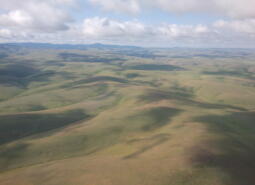
Washington ground squirrels are found in undisturbed shrub-steppe, sagebrush, or grassland habitat characterized by deep, loamy soils deposited by the Missoula Floods – some of the rarest ecosystems in the Oregon portion of the Columbia Plateau. They occupy sites with deep, loose, sandy loam soil suitable for burrows and with abundant forbs. They require sufficient patch size to maintain a colony and corridors that provide connectivity between colonies. Populations do fluctuate, and conservation planning needs to maintain areas occupied at peak numbers. The role of isolated colonies is also important as insurance against disease outbreaks and as refuges from wildfires.
The Washington ground squirrel has a very limited range and distribution due to these specific soil and vegetation needs and limitations in remaining parcels of undisturbed habitat. Concerns remain for continued loss of habitat, especially on private lands. Since state listing, the threat from wind energy development has grown substantially and the number of wind power projects is increasing in Washington ground squirrel habitat. Under current guidelines, sites actively occupied by Washington ground squirrel are considered irreplaceable, essential habitat, and are to be avoided.
Limiting factors
Habitat loss and fragmentation are the main factors limiting Washington ground squirrel populations. Wildfire risk is increasing with climate change and the spread of non-native invasive grasses in and around occupied habitat. Periodic disease outbreaks such as sylvatic plague also stress populations.
Data gaps
• Describe colony and metapopulation dynamics to understand how and why colonies appear and disappear and what factors contribute to expansion and extirpation of colonies.
• Further surveys to document occurrence of this species at historic and previously-unsurveyed areas.
• Assess disease impacts at colonies.
• Identify causes of elevated predation.
• Assess genetic diversity.
Conservation actions
• Maintain suitable habitat patches.
• Restore habitat connectivity where possible.
• Consider translocations as a recovery tool for instances of management and conservation concern.
• Consider experimental habitat creation or restoration in appropriate locations and soil/vegetation types.
• Conduct invasive species management in shrub-steppe habitat.
Key reference or plan
USFWS Washington Ground Squirrel Species Profile, Endangered and Threatened Wildlife; Morgan R. and M.J. Nugent. 1999. Status and Habitat Use of the Washington Ground Squirrel;