
Wayside aster is an erect perennial mostly 60-120 cm tall, growing from a stout caudex. The lowermost leaves are reduced and scale-like; those above are elliptic or broadly lanceolate, sessile, entire or with a few irregular teeth, 5-9 cm long by 1.5-3 cm wide and gradually reduced toward the inflorescence. Leaves are glabrous to glandular above and glandular-pubescent beneath. Several to many turbinate flowering heads are arranged in a leafy bracteate inflorescence. Disks are 1-1.5 cm wide, disk flowers yellow; ray flowers are typically lacking. Involucres are 0.8-1 cm high, the bracts imbricate, sharp-pointed with a strong midvein, somewhat keeled, and greenish above.
Overview
- Species Common Name Wayside aster
- Species Scientific Name Eucephalus vialis
- State Listing Status Threatened
Ecoregions
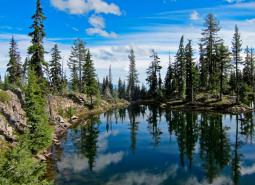
Klamath Mountains
The Klamath Mountains ecoregion covers much of southwestern Oregon, including the Klamath Mountains, Siskiyou Mountains, the interior valleys and foothills between these and the Cascade Range, and the Rogue and Umpqua river valleys. Several popular and scenic rivers run through the ecoregion, including the Umpqua, Rogue, Illinois, and Applegate rivers. Historically, this ecoregion is known …
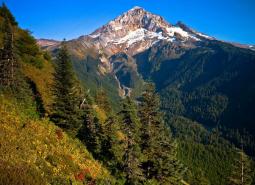
West Cascades
The West Cascades ecoregion extends from east of the Cascade Mountains summit to the foothills of the Willamette, Umpqua, and Rogue Valleys, and spans the entire length of the state of Oregon. It is largely dominated by conifer forests, moving into alpine parklands and dwarf shrubs at higher elevations.
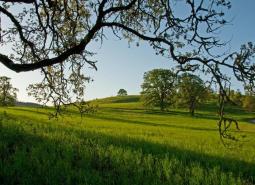
Willamette Valley
The Willamette Valley ecoregion is bounded on the west by the Coast Range and on the east by the Cascade Range. This long mostly level alluvial plain has some scattered areas of low basalt, and contrasts with productive farmland and large urban areas. It has the fastest-growing human population in the state resulting in challenges due to land-use changes.