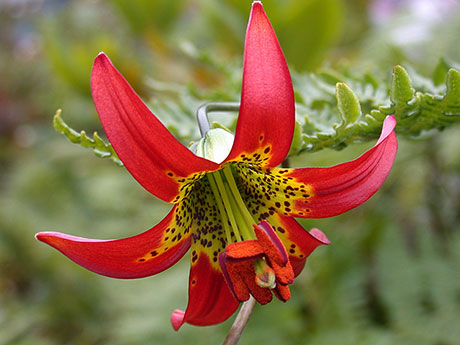
Western lily is a perennial that grows from a rhizomatous bulb, with a slender, unbranched stem 60-170 cm tall. The dark green leaves are narrowly oblanceolate, 622 cm long by 0.5-2.5 cm wide, and mostly scattered, with usually only the central leaves whorled. The showy, nodding flowers number 1-10 (25) on very long pedicels, the tepals linear-oblong, 4-5 cm long, and revolute half their length or more. The distal half to two-thirds of the tepals are crimson to deep red within, the basal part orange, yellow, or greenish yellow, sometimes shading to green in the throat, with maroon spots. The basal orange to yellow portion comes to a point near the midline of each tepal, giving the overall appearance of a central golden star when the flower is viewed from its open end. The stamens and style are nearly straight; the anthers are 0.4-1.2 cm long and closely grouped around the pistil. Capsules are broadly ellipsoid and 2-4 cm long. Seedlings and young plants produce a single above-ground leaf.
The western lily occurs in bogs composed of damp, slightly acidic and organic soils. This species is generally associated with small shrubs with nearby sunlight, and may use shrubs for mechanical support.
Limiting factors
The western lily has experienced significant habitat loss due to bog draining and filling, land conversion for agriculture, urban development, and road construction. Habitat degradation due to fire suppression has adversely affected this species; encroaching shrubs and trees block sunlight and can change hydrology. Soil compaction, plant collecting and flower picking, and grazing can also be harmful to western lilies. The species is highly vulnerable to climate change due to limited dispersal abilities, predicted increased variability in temperatures, and predicted alterations to hydrologic regimes.
Data gaps
Conduct studies of reproductive biology. This species may benefit from light grazing, which reduces competition from other plants; determine grazing regimes that maintain populations. Evaluate the effects of foraging by wildlife (e.g., small mammals, deer, elk). Evaluate genetics.
Conservation actions
Continue current conservation efforts, such as grazing management, propagation, and experimental vegetation management (e.g., prescribed fire, mowing). Maintain and restore bog hydrology. Avoid herbicide application during the growing season for roadside populations and use “No Spray” signs for educational purposes. Conduct annual monitoring. Follow recommendations in the Five Year Review.
Key reference or plan
A U.S. Fish and Wildlife Service Recovery Plan (https://ecos.fws.gov/docs/recovery_plan/980331b.pdf) was released for western lily in 1998. A 5-Year Review (https://ecos.fws.gov/docs/five_year_review/doc2408.pdf) for western lily was completed in 2009 by U.S. Fish and Wildlife Service.
Recovery Plan Amendment: https://ecos.fws.gov/docs/recovery_plan/Recovery%20Plan%20Amendment_LIOC.pdf