The Western Meadowlark (Sturnella neglecta) is a medium-sized songbird easily detected both visually and by its melodious call during the breeding season. Western Meadowlarks are uncommon to rare, and generally declining in appropriate habitat in western Oregon. In eastern Oregon they are a common species in steep decline: they are still widely distributed throughout the east side of the state, but have experienced steep population declines and are much less densely populated than they were historically.
They have long legs, a long narrow bill, flat head, and short tail. They are heavily streaked above with brown, black, and buff. Breeding adults have a distinctive bright yellow breast and black, V-shaped collar. Non-breeding adults are more muted in color, with a paler yellow breast and faint brown V-shaped collar. Adult male and female plumage is indistinguishable in the field, though males are larger than females. There are two recognized subspecies of Western Meadowlark (Sturnella neglecta), both occurring in Oregon; S. n. neglecta and S. n. confluenta.
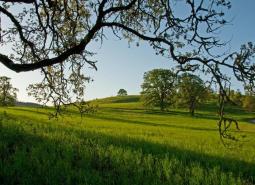
Western Meadowlarks require expansive grasslands for foraging and nesting. They may also use pastures or other open areas with low-lying vegetation. They prefer sites with high structural diversity, a mix of grasses and forbs, and vegetative cover <25 cm in height. Males commonly use scattered shrubs, trees, or fence posts as singing perches.
In the Willamette Valley, the Western Meadowlark’s preferred breeding habitat is open grassland with average grass height of 12 to 24 inches that includes structurally diverse herbaceous cover, scattered shrub cover, patches of bare ground, and limited tree cover. Prominent singing perches are a key structural component, and territories tend to include one or more trees that serve this purpose.
Limiting factors
Western Meadowlarks have large home ranges and are sensitive to loss, degradation, and fragmentation of grasslands. Meadowlarks are vulnerable to nest predation from raccoons, cats, and dogs. Human disturbance and activities (e.g., mowing) can cause meadowlarks to abandon nests.
Western Meadowlark populations have declined statewide, though they are still common in suitable habitats east of the Cascades. Populations of Western Meadowlarks west of the Cascades, especially in the Willamette Valley ecoregion, have experienced precipitous declines attributed to habitat loss and conversion. By 2015 the Western Meadowlark population in the Willamette Valley ecoregion was reported to be less than 1,500 birds.
Data gaps
• Conduct comprehensive survey effort in the Willamette Valley.
• Evaluate response of meadowlark productivity to prairie restoration in the Willamette Valley.
• Study demography for populations in altered prairie-oak habitats such as pasture, hay fields, airports, and urban and residential park-like oak woodlands and forests in the Willamette Valley.
Conservation actions
• Maintain and/or restore grassland habitat, especially large expanses (e.g., >100 acres).
• Promote overall structural diversity in grasslands: limit the cover of trees and shrubs (<10%), ensure a relatively high percent cover of native forbs (>10%) and bare ground (>5%), and provide good representation of all height classes.
• Increase plant diversity to promote greater insect diversity. Control key non-native plants, including reed canarygrass.
• Minimize disturbance during the breeding season (April 15-July 15).
Key reference or plan
The Willamette Valley Landowner’s Guide to Creating Habitat for Grassland Birds. Read here
Population and Habitat Objectives for Landbirds in Prairie, Oak, and Riparian Habitats of Western Oregon and Washington. Read here
Declining and State Sensitive Bird Species Breeding in Willamette Valley Grasslands: 2008/09 Status Update. Read here