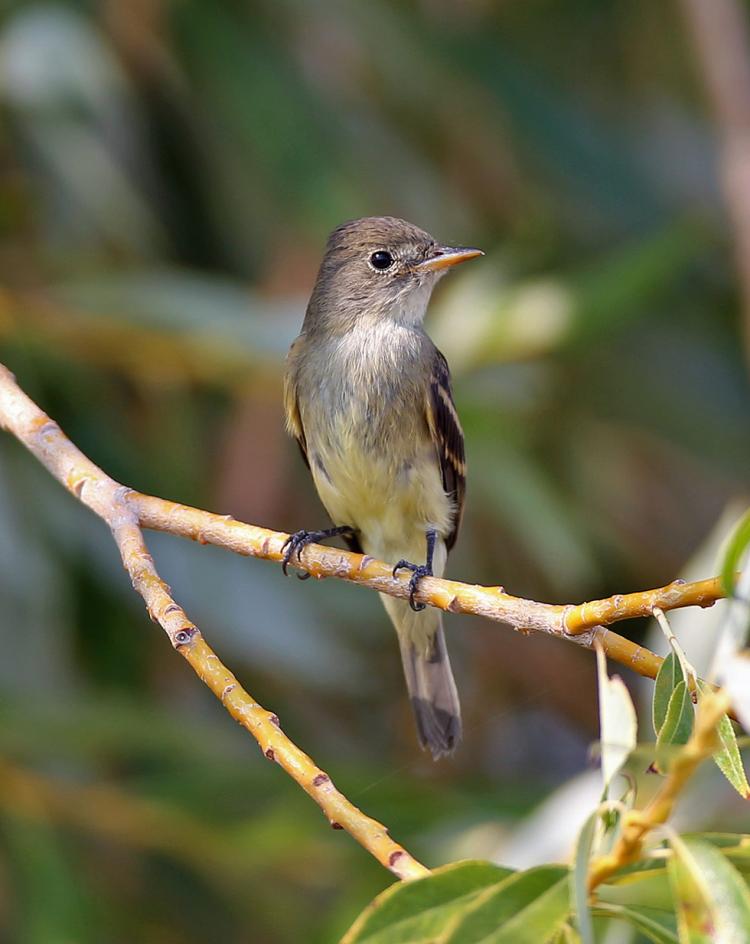
Willow Flycatchers are a small, slender flycatcher and are one of the larger members of the genus Empidonax. Due to strong similarities in appearance to other Empidonax flycatchers, they can be difficult to identify in the field without vocal cues. They are brownish olive overall with a slight yellow tint to the belly. Willow Flycatchers have two whitish wing bars and a white throat; their white eye ring is very narrow to nonexistent. They have a large, broad bill and dark feet. Males are not distinguished from females in appearance. Often perches on high or the tops of bushes to sing ‘fitz-bew’ song or call with a soft ‘whit’. Oregon is home to two recognized subspecies of Willow Flycatcher. E. t. adastus on the east side of the Cascade Range is paler and greener above, more greyish in the upper breast, and has paler tertial and secondary feather edges than E. t. brewsteri which inhabits lands west of the Cascades.
Overview
- Species Common Name Willow Flycatcher
- Species Scientific Name Empidonax traillii
- Federal Listing Status Species of Concern
- State Listing Status Sensitive
Ecoregions
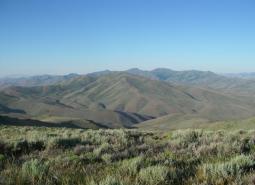
Northern Basin and Range
The Northern Basin and Range ecoregion covers the very large southeastern portion of the state, from Burns south to the Nevada border and from the Christmas Valley east to Idaho. It is largely a high elevation desert-like area dominated by sagebrush communities and habitats.
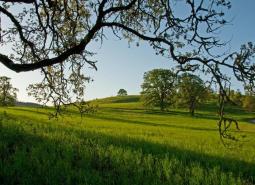
Willamette Valley
The Willamette Valley ecoregion is bounded on the west by the Coast Range and on the east by the Cascade Range. This long mostly level alluvial plain has some scattered areas of low basalt, and contrasts with productive farmland and large urban areas. It has the fastest-growing human population in the state resulting in challenges due to land-use changes.