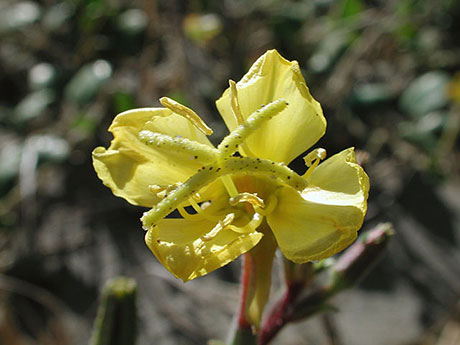
Wolf’s evening primrose is an erect, branching biennial to short-lived perennial, 5-15 dm tall, with greenish or red stems covered with stiff hairs. Plants form a basal rosette with elliptical leaves in the first year, and typically bolt and flower the following year. Flowers are pale yellow to yellow and are usually less than 4 cm in diameter. Sepals and fruits are often redtinged and pubescent.
Wolf’s evening primrose is found on patches of Cenozoic-era marine deposits that are well-drained but have adequate moisture. Habitat types include grasslands, coastal strand, roadsides, and coastal bluffs.
Limiting factors
Due to narrow habitat requirements, Wolf’s evening primrose has a disjunct distribution. Hybridization with garden evening-primrose (Oenothera glazioviana), a closely-related non-native ornamental plant, poses a serious threat to the genetic integrity of Wolf’s evening primrose. Habitat loss due to urban development, road construction, and herbicide use has also negatively impacted this species. Wolf’s evening primrose is highly vulnerable to climate change, particularly because of predicted sea level rise and increased variability in temperatures.
Data gaps
Evaluate the feasibility of starting new populations from cultivated plants. Determine the extent of hybridization with O. glazioviana.
Conservation actions
Avoid herbicide application and roadside/park maintenance activities during the growing season. Conduct public outreach about the problems caused by garden evening-primrose in areas where hybridization occurs.