METHODS FOR DETERMINING SPECIES OF GREATEST CONSERVATION NEED
The U.S. Fish and Wildlife Service (USFWS) requires all State Wildlife Action Plans to designate “Species of Greatest Conservation Need” as well as to provide specific information about problems that may affect those species, information needed to improve conservation, and recommended conservation actions. Oregon’s Species of Greatest Conservation Need (SGCN) list, Species of Greatest Information Need (SGIN) list, and associated species information were developed to meet this requirement. The SWAP identifies wildlife (amphibians, birds, mammals, and reptiles), fish, invertebrates, and plants and algae as SGCN and SGIN, including species occurring within the nearshore.
BACKGROUND
The original list of Species of Greatest Conservation Need was developed by regional biologists and species experts in 2006, referred to as Strategy Species in 2006 and 2016. This was done by first creating a list of all declining species in Oregon, and then using spatial models of Oregon’s vegetation types to produce species-habitat associations that estimated the extent of habitat loss experienced by each species. The 2006 SWAP also identified SGIN, referred to as Data Gap Species in 2006 and 2016, defined as species that may be of conservation concern, but insufficient information was available to fully assess whether they met the SGCN conservation criteria.
For the 2016 revision, all 2006 SGCN and SGIN were reviewed and updated. During the 2026 revision, all 2016 SGCN and SGIN species were reviewed for their conservation status and evaluated using the conservation criteria. Additional species were evaluated using the process described below. Information for each SGCN and SGIN was also updated. The Oregon Department of Fish and Wildlife (ODFW) divisions and partner organizations took the lead on reviewing and updating the various taxonomic groups.
WILDLIFE AND FISH CONSERVATION CRITERIA
The ODFW’s staff from Wildlife and Fish Divisions and the Marine Resources Program led a comprehensive review process for the Wildlife and Fish Species of Greatest Conservation Need list. The conservation criteria used, described below, were based on the criteria used in 2016 with changes to make them more inclusive of all taxa. Species were reviewed to determine whether to keep, remove, or add species using a two-step process.
- Species were first assessed for their eligibility for consideration as an SGCN.
To be eligible for consideration, species must be:- Native to Oregon in accordance with OAR 635-056-0010 (13) and
- Regularly occurring in Oregon (Figure 1)
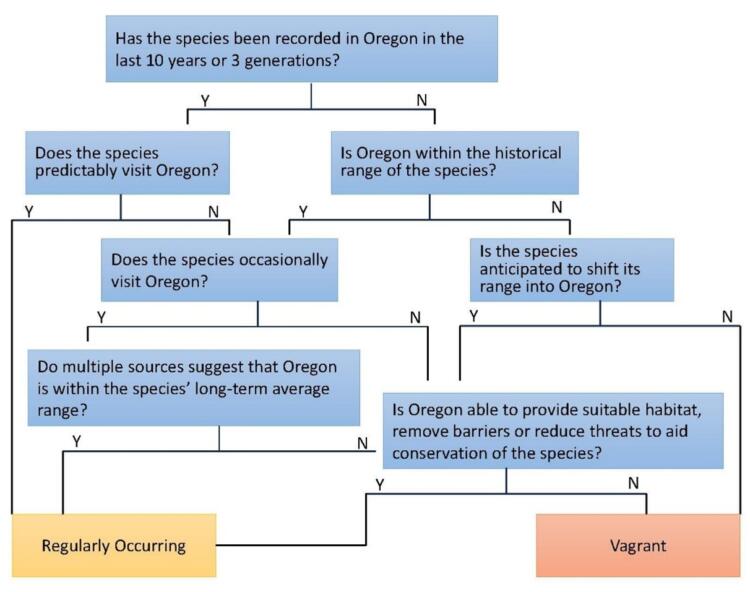
Figure 1. Decision tree used to determine if a species occurs regularly in Oregon. Adapted from the Convention on the Conservation of Migratory Species of Wild Animals, 2021. Native, regularly occurring species were then put forward to be reviewed for determination that they meet the criteria for being a SGCN under one or more of the three following conditions:
- Species has a conservation status ranking of at least one of the following:
- Federal listing – Endangered, threatened, or under review in the candidate or petition process
- State listing – Endangered or threatened
- IUCN Red List – Critically Endangered or Endangered
- NatureServe Global Rank – G1 or G2
- Oregon State Rank – S1 or S2
- NOAA – Overfished designation
- Other conservation status ranking that indicates a high risk of extinction or collapse
- Expert opinion suggests that the species should be reviewed
- Species has been petitioned for consideration by the public or partners
- Eligible species that were put forward under the above conditions were then assessed for listing as SGCN. A species must meet two or more of the following four criteria to be listed as an SGCN.
- The species is vulnerable to potential threats because of
(a) life history traits or strategies including but not limited to: low lifetime reproductive success, episodic reproduction, low recruitment, or the species gathers in high concentrations for some part of its life cycle (e.g., nesting, breeding, spawning, and/or feeding sites), or
(b) other ecological characteristics of the species including but not limited to: low dispersal ability or dependence on scarce or highly specific environmental conditions. - Population size or the number of occurrences of the species is either low or declining, indicating risk of extirpation or loss of population viability, in
(a) the ecoregion or
(b) statewide. - The species is at-risk because it has a restricted distribution. This includes but is not limited to species that: have had a significant retraction from historical geographic range, are at risk of extirpation from a catastrophic event due to narrow range, or represent a disjunct (isolated) population with low or highly restricted landscape or genetic connectivity.
- Populations of this species are known (or strongly suspected) to be vulnerable to a Key Conservation Issue or major threat, including:
1) climate change,
2) land use changes,
3) water quality and quantity,
4) barriers to animal movement,
5) disruption of disturbance regimes,
6) invasive species,
7) factors described in OAR 635-100-0105 subsection (6),
8) other known threats to populations (e.g., disease, trophic interactions, human recreation).
- The species is vulnerable to potential threats because of
Information from literature searches, agency and partner databases, and expert review was used to update the content associated with each SGCN, including special needs, limiting factors, data gaps, recommended conservation actions, and key references. ODFW consulted with species experts throughout Oregon to review and update the SGCN list and information associated with each species.
INVERTEBRATE SGCN LIST
ODFW consulted with experts from the Oregon Department of Agriculture, the ORBIC, the Xerces Society for Invertebrate Conservation, and other species experts to update the Invertebrate SGCN list and the information associated with each species. To the extent possible, the Wildlife and Fish Conservation Criteria were used to assess invertebrate species.
PLANT SGCN LIST
The list of SGCN Plants was updated to incorporate new species that were added to Oregon’s threatened and endangered plant species list. ODFW consulted with the ODA’s Plant Conservation Program and other species experts to update information regarding taxonomy, species descriptions, special needs, limiting factors, data gaps, recommended conservation actions, and key references. All terrestrial plant species descriptions are adapted from ODA’s plant species profiles.
ADDITIONAL MARINE SPECIES OF INTEREST LIST
Marine SGCN were selected using criteria as identified above. Additionally, any species that met at least one of the SGCN criteria were evaluated using the following Nearshore Criteria:
- Ecological importance – i.e. habitat forming, habitat engineer, keystone species, prey species.
- Economic/social/cultural importance – i.e. commercially important, recreationally important, culturally important to Oregon tribes, flagship or sentinel species.
Those species that met at least one of the Wildlife and Fish Conservation Criteria and at least one of the Nearshore Criteria are also specifically included in the SWAP as SGCN.